
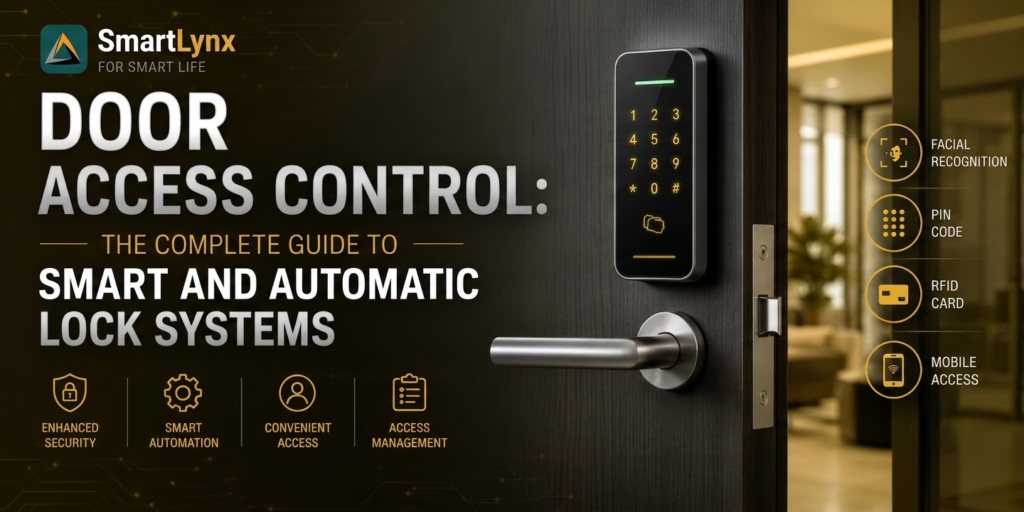
The Ultimate Guide to Door Access Control
Why It’s Time to Upgrade to Smart Security
A door access control system is a digital security solution that replaces traditional mechanical keys with electronic credentials—such as biometric fingerprints, PIN codes, RFID cards, or mobile applications—to strictly regulate who can enter a specific building or room and exactly when they are permitted inside. By matching modern smart locks with intelligent management software, these automated systems provide real-time entry tracking, instantaneous credential deactivation, and customized scheduling, giving both homeowners and businesses absolute control over physical access while eliminating the vulnerabilities of physical keys.
At SmartLynx, we believe that security shouldn’t feel like a chore. As our daily routines get more dynamic, managing access points across homes, offices, and commercial spaces requires something more responsive than a piece of cut metal. Moving to a smart door lock system isn’t just about looking futuristic—it’s about removing the daily friction and uncertainty of managing physical space.
Why Traditional Locks Fail the Modern Security Test
Traditional lock-and-key systems have protected us for centuries, but they are static solutions in a highly dynamic world. If you manage an active household or a growing office, traditional locks expose several systematic weak points:
- The Duplicate Dilemma: When physical keys are lost or copied by staff, contractors, or old tenants, your perimeter security drops to zero. Restoring absolute security means physically replacing the lock cylinders—a costly and time-consuming process.
- Zero Visibility (No Audit Trail): A standard mechanical lock operates silently. It cannot tell you what time your kids got home from school, when the cleaning crew left, or if an unauthorized employee entered a storage room after hours.
- The Management Bottleneck: Managing one front door with a key is simple. Managing a main entrance, a back service door, an interior office, and a terrace access point quickly devolves into an unorganized, heavy ring of keys.
Modern door access control shifts security from a reactive headache to a seamless, automated background process.
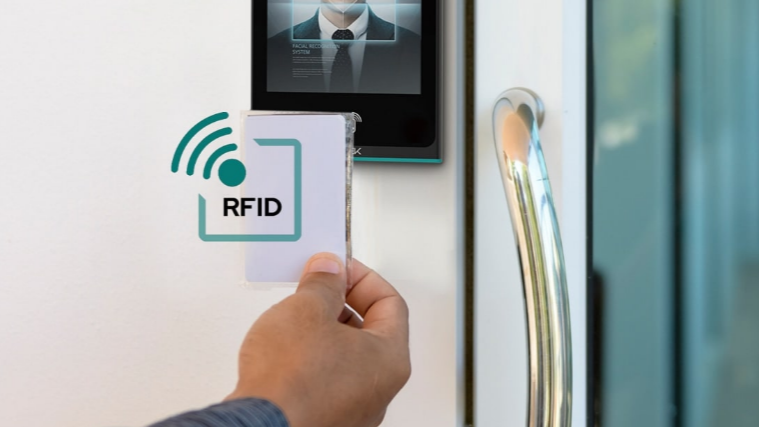
RFID card authentication in a smart access control ecosystem. Source: ARATEK
Choosing the Right Access Control Technology
Every facility has different traffic patterns and security needs. Understanding the technical mechanisms available helps you pinpoint the ideal setup for your daily environment:
1. Biometric Access Control
Biometrics rely on unique physical data—typically a fingerprint scan or facial recognition. Because your biometric signature cannot be borrowed, stolen, or accidentally left on a desk, it offers an incredibly high level of intrinsic security. For a premium residential entrance, it means unlocking the door naturally, even when your hands are full of groceries.
2. RFID Access Control
Radio-Frequency Identification (RFID) systems use small chips embedded inside key fobs, plastic cards, or wristbands. When held near a reader, the reader recognizes the credential’s unique encrypted code instantly. This is the gold standard for office spaces and commercial hubs because deploying or revoking cards for hundreds of employees takes only a few clicks on a dashboard.
3. PIN-Based Keypads
Keypad access systems drop the requirement for any physical asset whatsoever. Users simply memorize a numeric code. This is exceptionally helpful for short-term rental properties or utility rooms, allowing you to text a temporary access code to a guest or technician and change it automatically when they leave.
4. Smart Door Lock Systems
A true smart door lock integrates multiple entry pathways simultaneously—giving you fingerprint entry, backup PIN access, and full remote control via a mobile app. If a delivery driver arrives with an urgent package while you are trapped in a work meeting miles away, you can verify their identity via a doorbell camera and unlock the door remotely.
Comparing the Systems at a Glance
| Access Type | Security Level | Primary User Benefit | Ideal Application |
| Biometric | Exceptionally High | Cannot be lost, shared, or cloned | Main home doors, executive suites |
| RFID Cards | High | Ultra-fast throughput, cheap to replace | Corporate offices, hotels, gyms |
| PIN Keypads | Medium-High | Complete keyless freedom, digital sharing | Airbnbs, shared storage, garages |
| Smart App Lock | High | Remote control, instant activity updates | Modern smart homes, remote offices |
How to Transition to a Modern Keyless System
Migrating away from traditional keys doesn’t have to disrupt your daily routine. A seamless integration follows a distinct, structural path to ensure complete hardware and software alignment:
1.Evaluate the Openings:Site Audit.
Assess your existing physical doors. Timber doors handle mortise-style smart locks cleanly, while commercial glass or aluminum doors typically require electromagnetic plate locks or electric strikes.
2.Select Credentials and Power Structure:System Design.
Determine your user base. Choose biometric scanners for families or RFID fobs for large office teams. Ensure your system includes reliable battery backups or an internal power supply loop to keep running during power grid outages.
3.Install Hardware and Locking Elements:Physical Implementation.
Mount the digital access readers externally and secure the mechanical locking mechanisms to the frame. Wire the components to an internal controller that acts as the local brain of the door.
4.Map Permissions and Access Schedules:Software Configuration.
Launch your management console. Build user profiles and assign clear schedules—such as allowing your house helper access exclusively between 9:00 AM and 11:00 AM on weekdays.
Frequently Asked Questions
Can a smart door lock system work during a total power outage?
Yes. Quality residential smart locks run on isolated internal batteries, meaning they remain 100% operational regardless of the main power grid. For commercial systems wired to building power, central controllers use backup batteries to maintain system integrity. Additionally, many modern smart locks incorporate an external emergency Type-C USB port, allowing you to plug in a portable power bank to temporarily fire up a dead lock and enter safely.
Is an automatic door lock system safe for residential homes?
Absolutely. An automatic lock system ensures that the moment a door completely shuts, the latch or bolt engages immediately. This completely eliminates the human error of forgetting to lock up at night or leaving the front door vulnerable when rushing out to work in the morning.
How secure is biometric door access control against spoofing?
Modern biometric sensors utilize live-tissue detection and advanced capacitive reading. They look for the heat and electrical conductivity of a real finger, making it practically impossible to bypass using simple 2D printouts or silicone mold duplicates.
With a customized SmartLynx setup, your physical spaces adapt directly to your lifestyle, keeping you informed, secure, and entirely key-free.